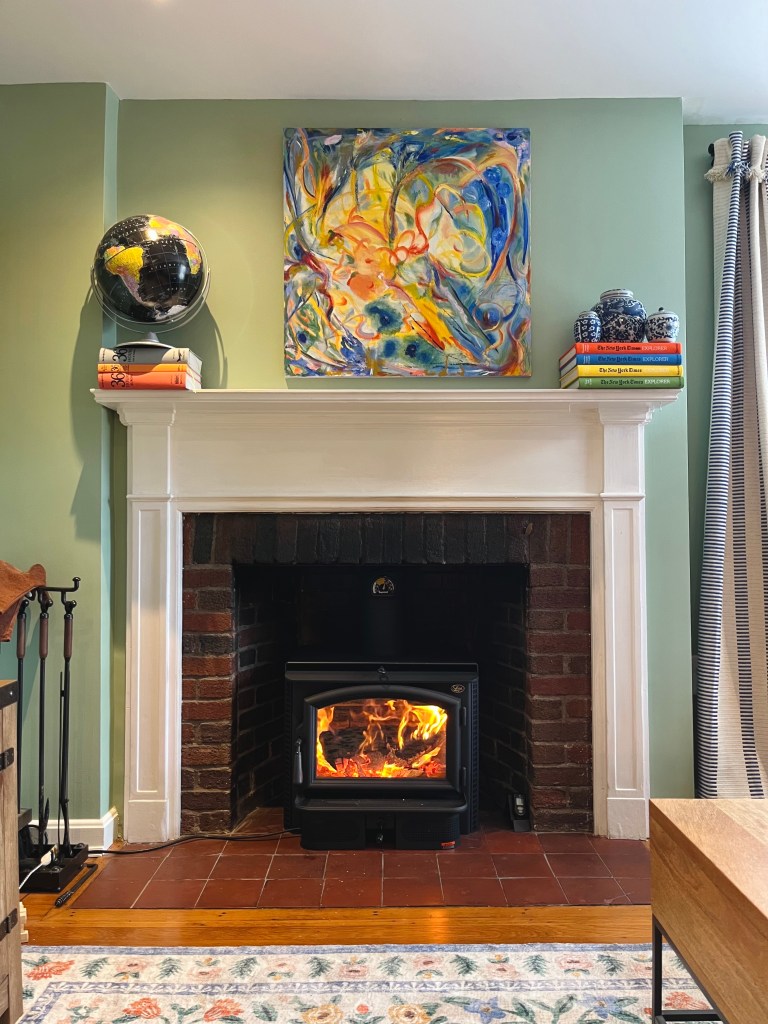
My husband’s one big request for our home was to get a wood burning fireplace insert for our living room. I wasn’t opposed to the idea, but for something we didn’t really need, we both agreed that we would revisit the conversation a few years down the road when money didn’t feel so tight. And then we got our first 2025 heating bill.
If you live in Massachusetts, you know exactly what I’m talking about. The coldest winter we’ve had in years combined with a 30%+ increase in both gas and electric heating delivery charges led to some truly mind boggling bills. So, we decided to put some other purchases on hold and instead fast-track our plans for the insert.
Our fireplace is on the smaller side, so we ended up going with the Lopi Answer NexGen-Hybrid™ Wood Burning Insert. (For locals, we purchased it here and had a really positive experience.)
What appealed to us about the insert is that it is a very efficient way to heat our home. As much as we loved the ambience of our traditional wood burning fireplace, we were disappointed to learn that most of the heat actually escapes. Inserts are much more efficient. Plus, all of the models we were looking at are EPA certified to reduce emissions (and available for a 30% tax credit, at least as of this writing). Our two-story home is also well suited for an insert, as it is small (roughly 1350 square feet) with a very open floor plan.
I’ve been really drawn to English countryside interiors, and wood stoves have that cozy countryside look that I love. Another big appeal of the insert is that we only have to pay for wood, which we would buy in bulk at the beginning of the season. There is no utility cost of running it (aside from the optional blower fan). We hope to use it as supplemental heat to help us taper down our natural gas usage. We’re still figuring out the most efficient way to use the stove, but so far we’re really happy with it. During a particularly cold March weekend, we were able to turn our thermostat off completely and heat our home with the insert alone.
The insert is also an attempt to solve a winter pain point – heating a downstairs sunroom/office that was an addition, and therefore the only room that doesn’t have ductwork on our central air / forced heat system. This room is just a few yards away from the living room with big French doors to let the heat in. So far, the stove insert seems to be helping.
For any fellow New Englanders who are looking to taper down their utility usage, I highly recommend seeing if your fireplace is suitable for a wood stove insert!
 Bookworm Cottage Style
Leave a comment