When back-to-school season rolls around, I find myself more drawn to nonfiction to scratch the educational itch. If you find yourself in the same boat, I’ve read and would recommend any of these titles.
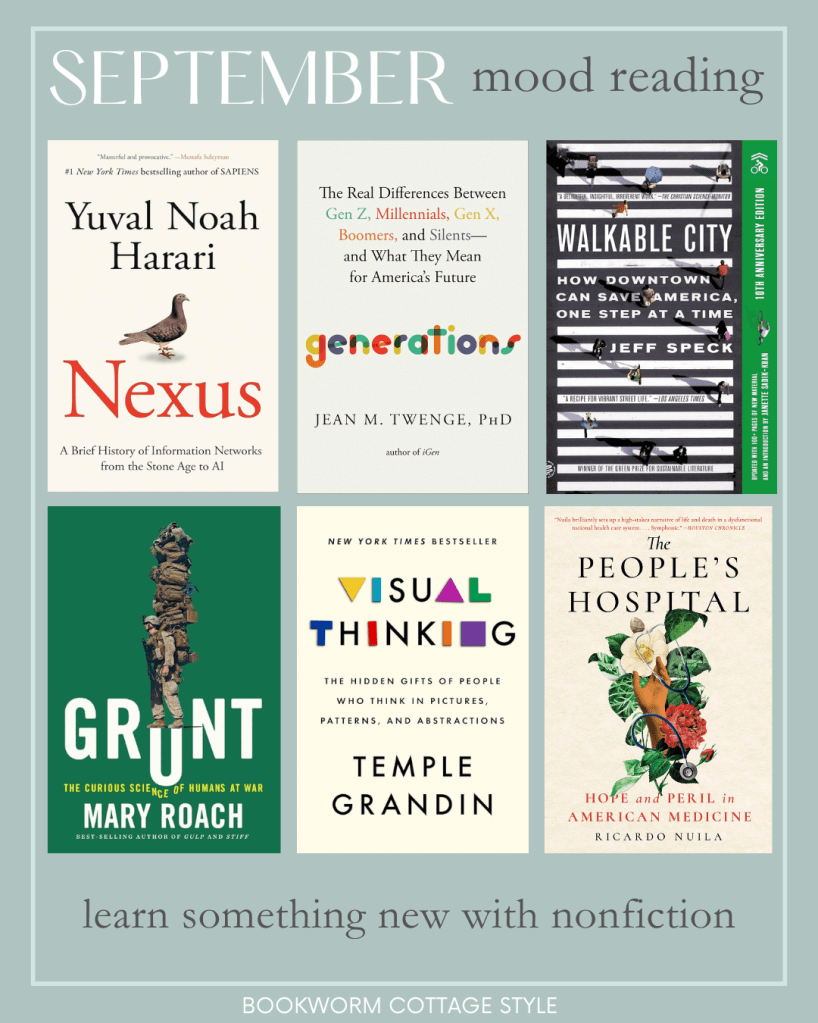
Nexus: A Brief History of Information Networks from the Stone Age to AI by Yuval Noah Harari (2024; 520 pages) // This is an excellent, thought-provoking book to read to better understand the political moment we find ourselves in, and also the impact that AI may have (and is already having) on humanity. But don’t just take my word for it… Tom Hanks says this that if you only read one nonfiction book this year, this should be the one. Using examples from all across history, the author explains why having access to more information via the internet doesn’t necessarily lead to better information, and yet how systems that seek to limit information flow also lead to dangerous outcomes. I did not fully understand the gravity of something as seemingly harmless as a social media algorithm until reading this book. The author makes a clear case that AI (specifically, the algorithm) has already led to the loss of human life, such as in the 2016 genocide in Myanmar. While this is a dark and startling read, it is not entirely hopeless. The author outlines clear suggestions of how humans (especially governments) can step up to regulate how AI is used in order maximize the benefit of the technology while minimizing potential unintended consequences.
Generations: The Real Differences Between Gen Z, Millennials, Gen X, Boomers, and Silents―and What They Mean for America’s Future by Jean M. Twenge (2023; 560 pages) // This book takes a fascinating deep dive into each of the generations using extensive data to explore the differences in politics, family size, wealth, leadership, mental health, and more between the various generations. This is truly a really interesting book and I would definitely recommend it to any nonfiction fan. I also think it would make an excellent book club pick as there is a lot to discuss! And yet as a millennial, I have a major gripe about the millennial section. The author continually emphasizes that millennials are making more money relative to inflation compared with other generations at the same age, and that millennials “feeling” broke has more to do with the fact that we got too many participation trophies growing up and all expect our lives to be exceptional. This glosses over a HUGE factor at play here — namely, cost of housing. The huge increase in home prices relative to inflation means that many millennials are not able to afford the same types of homes they grew up in, despite making significantly more money than their parents did and despite lower historic interest rates than their parents faced. Setting this aside, I really did enjoy this book and learned a lot!!
Walkable City: How Downtown Can Save America, One Step at a Time by Jeff Speck (2012; 312 pages) // The walkability of Boston and many of its suburbs is one of the things I love most about where I live. Speck’s research and experience in city development help articulate why small tweaks in street layout and city planning make such a big difference, and why some cities have such enduring appeal over others. I thought a lot about the lessons in this book while house hunting, and would recommend it to any nonfiction fan.
Grunt: The Curious Science of Humans at War by Mary Roach (2016; 288 pages) // Mary Roach is widely recognized as one of the funniest science writers, and I absolutely adore her hilarious books. Her curiosity-driven reporting helps democratize science and get people interested in learning. Gut is probably my favorite of her books, but I went with this one because even though war is outside my realm of interests, I found this to be fun and fascinating. This book is supposed to be about the military, but in all honesty it is not really about the military at all… It is a series of essays about military-adjacent topics, such as stink bombs and underwear and caffeine. If you’re squeamish about poop jokes then Mary Roach is not the writer for you. But for anyone else, I highly recommend this book! I also think it would be a great read to get teens interested in science as her books interview people with unusual careers in specialized fields.
Visual Thinking: The Hidden Gifts of People Who Think in Pictures, Patterns, and Abstractions by Temple Grandin (2022; 340 pages) // This is a great book and I’m surprised not more people are talking about it! Written by a woman with autism, this book explores the power of “visual thinkers” and how their unique perspective is a necessary part of a productive, functioning workforce. This book completely reshaped the way I think about education, skilled trades, neurodiversity, and varieties of learning styles. I would recommend this to educators, parents, hiring managers, and any and all nonfiction fans. A fascinating, thought-provoking, solutions-oriented read!
The People’s Hospital: Hope and Peril in American Medicine by Ricardo Nuila (2020; 370 pages) // If you work in healthcare or at all interested in better understanding our broken healthcare system, you must read this book! The author is a doctor at Ben Taub Hospital in Houston, a safety net hospital caring for the uninsured. Using powerful stories from real-life patients, Dr. Nuila invites readers to explore a completely different approach to healthcare. This book was eye-opening, frustrating, inspiring, and powerful, and I highly recommend it.
For more nonfiction recommendations, see my January 2024 reading roundup or my April 2025 reading roundup. As for me, some new-ish nonfiction books that I’m interested in reading include There Is No Place for Us: Working and Homeless in America; The CIA Book Club: The Secret Mission to Win the Cold War with Forbidden Literature; The Everything War: Amazon’s Ruthless Quest to Own the World and Remake Corporate Power; Wear It Well: Reclaim Your Closet and Rediscover the Joy of Getting Dressed; and Careless People: A Cautionary Tale of Power, Greed, and Lost Idealism.
 Bookworm Cottage Style
Leave a comment