The censorship occurring at the federal level is nothing short of terrifying. Reading nonfiction is one small but mighty way to stay informed and build empathy. Each of these books offer an immersive look at a systems-based or justice-related topic, and you will not walk away the same person you were before reading. These are not just informative, they are spectacularly moving. As always, I have read and highly recommended every book on this list.
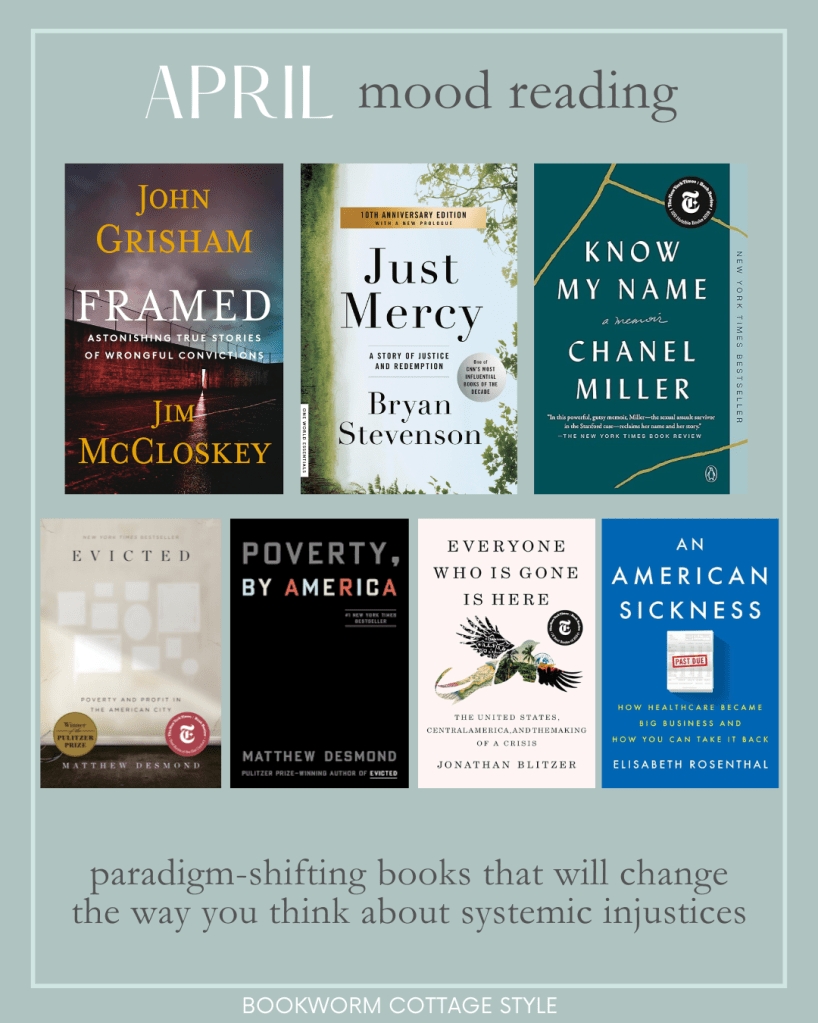
Framed: Astonishing True Stories of Wrongful Convictions by John Grisham and Jim McCloskey (2024; 368 pages) // Wow! This book, John Grisham’s rare foray into nonfiction, is painful to read but it is so so good! With co-author Jim McCloskey, founder of Centurion Ministries, the authors share 10 chapters, each focused on a different case of someone wrongly accused of a serious crime who spent years of their life imprisoned. These cases were not due to errors or mistakes. In each of these cases, law enforcement officers knowingly persecuted people who they knew to be innocent due to their own egos or prejudice or outside pressure to “solve” a case. This is a great companion read to Bryan Stevenson’s book, Just Mercy, as it provides a window into the criminal justice system from an entirely different and yet equally haunting angle. I think this would make for a great book club pick.
Just Mercy: A Story of Justice and Redemption, by Bryan Stevenson (2016; 368 pages) // I will continue to keep recommending this book until everyone I know has read it, because it is truly the most powerful book I’ve ever encountered. If you are new here, this book is a memoir written by an attorney representing individuals on death row. The book gives readers an urgent view of mass incarceration and the painful legacy of structural racism that is still in place today.
Know My Name by Chanel Miller (2019; 384 pages) // This powerful memoir is written by Chanel Miller, the survivor of the Stanford sexual assault case, but it is not simply the retelling of an assault. Instead, Know My Name is a powerful look at the emotional, financial, and logistical obstacles put in place by our legal system and other institutions when survivors come forward. Miller is a profoundly gifted writer, and women all over the world are lucky to have her in our corner. This is one of those books that has the power to make the world a safer and more empathetic place, and should be required reading for all.
Evicted: Poverty and Profit in the American City by Matthew Desmond (2016, 418 pages) // This book follows eight families in Milwaukee as they try to keep a roof over their heads despite exploitation, poverty, and circumstances beyond their control. This is one of the most profound nonfiction books I’ve read, and I highly recommend it! This book also won the Pulitzer Prize for General Nonfiction, the National Book Critics Circle Award, Carnegie Medal, and the PEN / John Kenneth Galbraith Award for Nonfiction.
Poverty, By America by Matthew Desmond (2023, 304 pages) // This is such a good book!! From the author of Evicted (another book I loved and would highly recommend), this book explores the roots and realities of poverty and income inequality in America, and what we can do to help mend it. This book is less narrative than Evicted but every bit as powerful. Highly highly recommend!
Everyone Who is Gone is Here: The United States, Central America, and the Making of a Crisis by Jonathan Blitzer (2024, 544 pages) // Named a New York Times Top 10 Book of 2024, this book is about the crisis at the southern border. Despite growing up in a border state, I truly had no idea about all of the factors impacting immigration or how precarious the asylum seeking process is. This book follows the lives of a handful of immigrants from Central America. The story was so informative without being dry or wonky, and I found myself getting swept away in the narrative. The reporting, research, and storytelling are excellent. If you want to learn more about foreign policy or the immigration crisis, this is a must read!
An American Sickness: How Healthcare Became Big Business and How You Can Take It Back by Elisabeth Rosenthal (2017, 656 pages) // I read this years ago (pre-covid!) but the American healthcare situation has only become more dire. This book clearly helps reader understand how we got to a place where healthcare bills are the number cause of bankruptcy and why American health outcomes fall behind that of our peers in many measures. The author also highlights creative approaches to healthcare from other countries as well as tips for people trying to navigate our complex healthcare system without being unfairly exploited. Whether you work in healthcare or simply want to stay healthy and financially afloat, this is a must-read!
I’d love to hear which nonfiction books have been particularly paradigm-altering for you! What else should I be reading?
 Bookworm Cottage Style
Leave a reply to September Mood Reading: Nonfiction – Bookworm Cottage Style Cancel reply